
On this page
- Buildings and systems
- Sizing for Georgia rain
- Where the water goes
- Maintenance
- What to specify
- Commercial gutter terms
- How are commercial gutters installed?
- What size gutters does a commercial building need?
- Flat roofs: scuppers and collector heads
- Who is responsible in a shopping center or HOA?
- How often should commercial gutters be cleaned?
- Does commercial gutter work need a license in Georgia?
- What should a property manager ask for in a quote?
- What goes wrong with commercial gutters?
- How are multi-unit buildings handled?
- How long does a commercial gutter project take?
- What records should a manager keep?
Buildings and systems
| Building | Usual system |
|---|---|
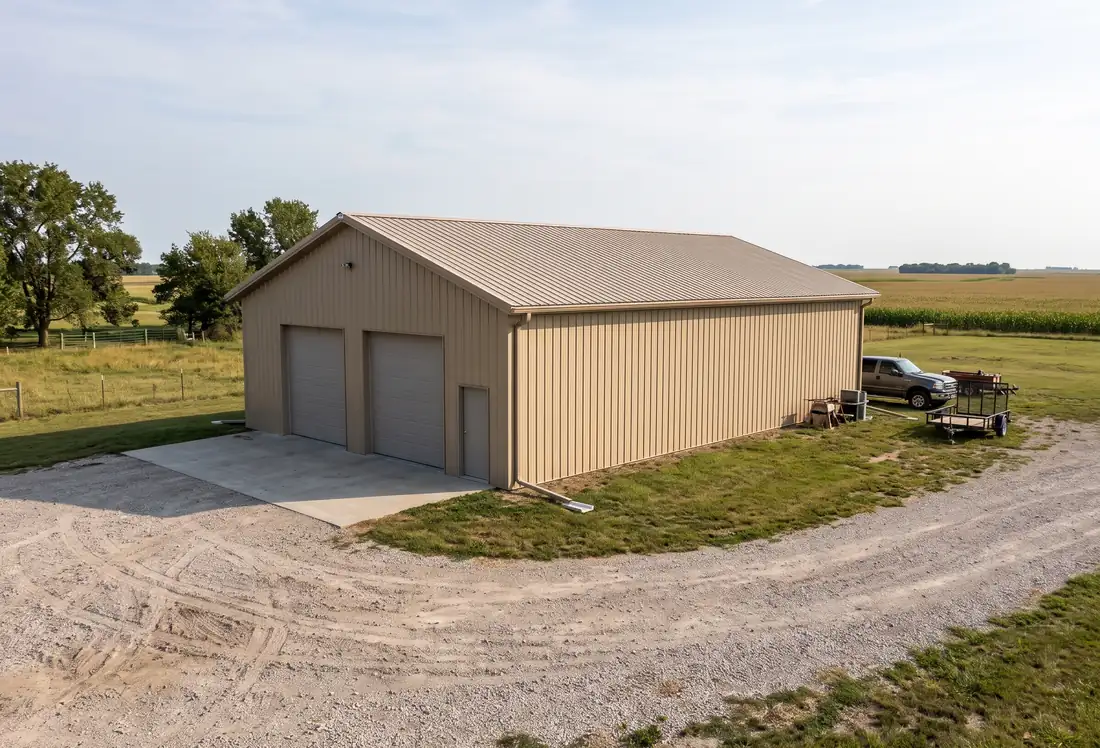
| Metal warehouse or workshop | Box gutter in matching steel, with 4x5 or larger downspouts |
| Strip retail and offices | 6-inch or 7-inch K-style or box gutter, often behind a parapet |
| Churches and schools | Large K-style or half-round, sometimes copper on older buildings |
| Apartment and townhouse blocks | 6-inch seamless aluminum, with attention to shared downspouts |
Sizing for Georgia rain
Commercial gutters are sized from roof area, pitch and local rainfall intensity. With about 54.6 inches of rain a year and intense summer storms, undersized outlets are the common fault. A large roof needs more and bigger downspouts, not only a wider gutter.
Where the water goes
On a commercial site the downspouts usually connect to underground storm drains or discharge to a detention area. Anything that changes how stormwater leaves a site may need approval. Ask the City of Marietta or Cobb County before altering connections.
Maintenance
Flat and low-slope roofs collect debris at scuppers and outlets. Under pines, quarterly checks are sensible. Many property managers arrange a standing cleaning schedule.
What to specify
- Gauge and metal of the gutter and downspouts
- Hanger or bracket type and spacing
- Expansion joints on long runs
- Outlet size and number
- How the system connects at ground level
Commercial gutter terms
| Term | Meaning |
|---|---|
| Box gutter | A large rectangular gutter, usually steel, used on commercial and metal buildings |
| Scupper | An opening through a parapet wall that lets water off a flat roof |
| Collector head | A box at the top of a downspout that takes water from a scupper or two gutters. Also called a conductor head |
| Downspout | The vertical pipe from gutter to ground. Also called a leader |
| Expansion joint | A flexible joint that lets a long run grow and shrink with temperature |
| Outlet | The drop tube sealed into a hole in the gutter floor. The downspout connects to it |
| Gauge | Metal thickness. Residential aluminum is 0.027 or 0.032 inch. Copper is sold as 16 or 20 ounce |
| Strap | The band that fixes a downspout to the wall |
| Cleanout | An access fitting at the foot of a downspout where it enters a buried pipe |
How are commercial gutters installed?
- The roof area, pitch and drainage points are surveyed
- Gutter and downspout sizes are worked out from the roof area and design rainfall
- Brackets or hangers are set to a line at the spacing the gutter size requires
- Gutter sections are lifted into place, lapped, fastened and sealed
- Expansion joints are fitted on long runs
- Downspouts are fixed and connected to the storm drain or discharge point
- The system is water-tested
Work at height on commercial buildings often needs a lift and a site safety plan.
What size gutters does a commercial building need?
Larger than a house, and worked out by calculation. A metal warehouse may need 7-inch or 8-inch box gutter with 4x5 downspouts. With about 54.6 inches of rain a year and intense summer storms, outlets are the usual weak point.
| Roof | Typical gutter | Typical downspout |
|---|---|---|
| Small shop or office | 6-inch K-style | 3x4 |
| Church or school wing | 6-inch or 7-inch K-style | 3x4 or 4x5 |
| Metal warehouse | 7-inch or 8-inch box | 4x5 or larger |
| Flat roof with parapet | Scuppers and collector heads | 4x5 or round |
Flat roofs: scuppers and collector heads
A flat or low-slope roof behind a parapet drains through scuppers in the wall. Each scupper empties into a collector head at the top of a downspout. If a scupper blocks, water ponds on the roof. Overflow scuppers set a little higher are a safety measure.
Who is responsible in a shopping center or HOA?
It depends on the lease or the association documents. Tenants should check before arranging work on a shared roof edge. Managers of townhouse and condominium communities usually arrange gutter cleaning and repair for the whole property.
How often should commercial gutters be cleaned?
At least twice a year. Quarterly under pines, and after any severe storm. Low-slope roofs collect debris at the outlets, where one handful of pine straw can block a scupper.
Does commercial gutter work need a license in Georgia?
Georgia lists gutters and downspouts as a traditional specialty, outside the residential and general contractor license. Work that goes beyond that scope, or that forms part of a larger building contract, may fall under other rules. Property managers usually ask for a certificate of liability insurance.
What should a property manager ask for in a quote?
- Gutter and downspout sizes, and the roof areas they were sized from
- Metal, gauge and finish
- Bracket spacing and expansion joint locations
- How downspouts connect at grade
- Access method and any disruption to tenants
- A certificate of liability insurance
- A maintenance schedule
What goes wrong with commercial gutters?
| Fault | Cause |
|---|---|
| Ponding on a flat roof | Blocked scupper or outlet |
| Leaks at laps | Sealant aged, no expansion joint |
| Gutter pulling off a metal building | Bracket spacing too wide for the load |
| Downspouts crushed at the base | Vehicles. Fit bollards or guards |
| Staining down a wall | Overflow at an undersized outlet |
How are multi-unit buildings handled?
Townhouse and apartment buildings share long runs. Work is planned building by building, and residents are told when ladders or lifts will be outside. A manager usually wants one visit that covers cleaning, a condition report and small repairs.
How long does a commercial gutter project take?
A small shop or office is a day or two. A warehouse or a multi-building residential community is planned in phases over a week or more, depending on access and weather. Ask for a schedule building by building, with the days each entrance or parking area will be affected.
What records should a manager keep?
Dates of cleaning, photographs of each roof drain and scupper, and a note of any repair. They help when a leak appears and when the property is sold or insured.