
On this page
- What is the gutter doing?
- Why gutters fail here
- Repair or replace
- What a repair visit covers
- Parts a repair may involve
- How do you repair a gutter?
- What does gutter repair cost in Marietta?
- Can I repair gutters myself?
- When should a repair not wait?
- Which repairs are most common here?
- What will a contractor need to know when I call?
What is the gutter doing?
| What you see | Likely cause | Page |
|---|---|---|
| Drip at a corner or end | Sealant has dried and cracked | Leaking gutters |
| Water pouring over the front edge | Blockage, too few downspouts or gutter too small | Overflowing gutters |
| Run bowing or pulling off the wall | Loose spikes, rotted fascia or weight of debris | Sagging gutters |
| Soft, stained or peeling board behind the gutter | Water getting behind the gutter | Fascia and soffit |
| Downspout loose, crushed or backing up | Blockage, mower damage or a failed strap | Downspout repair |
| Dents, creases or a section down after a storm | Wind, hail or a fallen limb | Storm damage |
Water pours over the front edge in heavy rain
Most often a clog at the downspout outlet, or a run that has lost its slope and holds water in the middle. On steep or large roofs it can also mean 5-inch gutters are undersized for the roof area. The fix is to clear the outlet, check the pitch with a level, and re-hang the run or go up a size if needed. See 6-inch gutters.
A steady drip at a corner or end
Sealant at a miter or end cap has dried out and cracked. Corners and end caps are the only joints in a seamless system, so this is the most common leak of all. The joint is cleaned back to bare metal and resealed. See leak repair.
The gutter sags or is pulling away from the house
Hangers have loosened or are spaced too far apart, often under the weight of wet debris. If the fascia board behind is soft, new screws will not hold until the wood is replaced. See sagging gutters and fascia repair.
Dents, creases or a section down after a storm
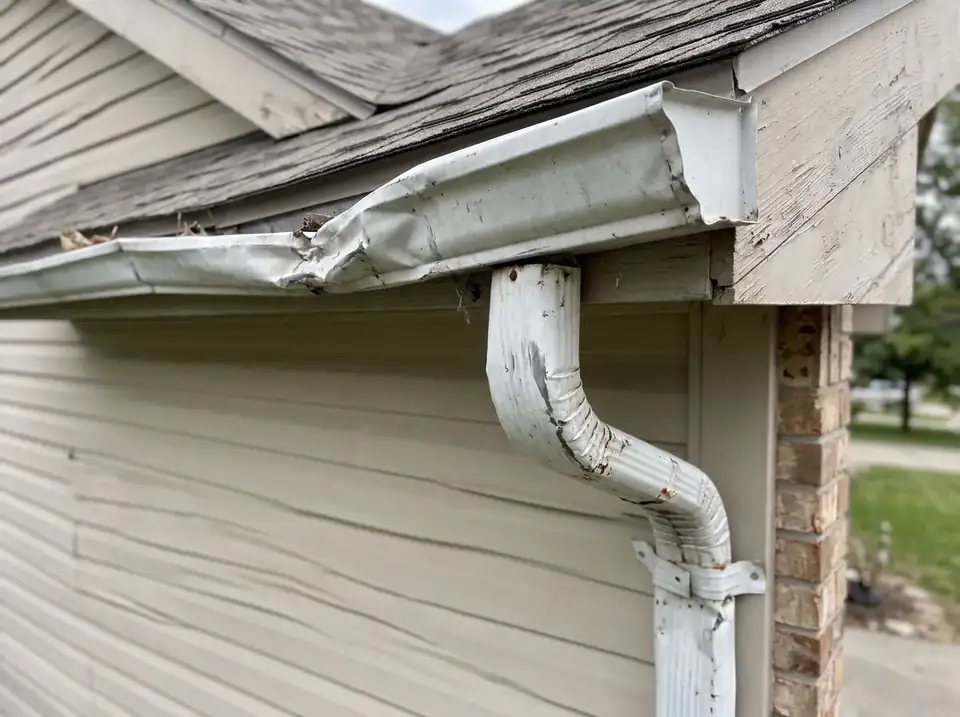
Small dents are usually cosmetic. A crease across the gutter, split seams and crushed downspouts affect how the system drains. The storm damage guide explains what to photograph and how insurance usually treats it.
Water pools by the foundation or in a window well
The downspout is discharging too close to the house, or an underground drain line is blocked. An extension or a re-routed downspout usually solves it. See downspout repair.
Pine straw matted in the gutter and downspouts backing up
Needles knit into a mat and bridge across the outlet. Clearing them is the first step. If it keeps happening, a larger outlet with a 3x4 downspout, or fine micro-mesh guards, is the lasting fix. See pine straw and gutters.
Why gutters fail here
Weight. Wet pine straw and leaves are heavy. A gutter that stays full for a season pulls on its fixings every time it rains, and old spikes work loose.
Humidity and rot. Marietta has a humid subtropical climate. Wood that gets wet behind a gutter stays wet. Fascia rot is the hidden cause of many sagging runs, because a screw will not hold in soft wood.
Heat. Long hot summers dry out sealant. Corners sealed ten or fifteen years ago are often the first thing to drip.
Trees. Limbs come down in thunderstorms, and a single branch can crease a run or tear a downspout off the wall.
Repair or replace
Repair makes sense when the metal is straight and the fault is in one place. Replacement is worth pricing when:
- the gutter is creased or twisted along its length
- several corners and joints have already been patched
- the fascia has rotted along most of a run, so the gutter has to come down anyway
- the system was too small for the roof from the start
The guide to repair or replace goes through the decision.
What a repair visit covers
A contractor will normally clear the run first, because a fault cannot be judged through debris. Then the run is checked for fall with a level, the fixings are tested, corners and outlets are inspected, and the fascia is probed. Ask for the findings in plain terms and a price for each item, so you can choose what to do now and what can wait.
Parts a repair may involve
| Term | Meaning |
|---|---|
| Hidden hanger | A clip inside the gutter with a long screw through the back into the fascia |
| Spike and ferrule | The older fixing: a long nail through the gutter and a metal tube. It works loose with time |
| Fascia | The board fixed across the ends of the rafters. The gutter hangs on it |
| Soffit | The underside of the eave, between the fascia and the wall |
| Drip edge | Metal flashing under the first row of shingles that sends water into the gutter and not behind it |
| Gutter apron | A wider L-shaped flashing that laps from the roof deck into the gutter. Used where drip edge is missing or short |
| Strip miter | A corner made by cutting both gutters at 45 degrees and covering the joint with a metal strip |
| End cap | The flat piece that closes the end of a run |
| Outlet | The drop tube sealed into a hole in the gutter floor. The downspout connects to it |
| Elbow | The angled piece that turns a downspout. A-style turns front to back. B-style turns side to side |
| Strap | The band that fixes a downspout to the wall |
| Sealant | The flexible compound applied inside joints. It is the part that ages |
| Fall | The slope of a gutter toward its outlet, about a quarter inch in ten feet |
How do you repair a gutter?
It depends on the fault, but the method is the same each time:
- Clear the gutter so the fault can be seen
- Run water and watch where it goes
- Check the fall with a level
- Test the fixings and probe the fascia
- Fix the cause: reseal, re-hang, replace a section or add an outlet
- Run water again to prove the repair
What does gutter repair cost in Marietta?
There is no published local price list. Cost follows the time on site and the height. As a guide to order of size:
| Repair | Relative cost |
|---|---|
| Reseal one corner or end cap | Low |
| Clear a blocked downspout | Low |
| Re-hang a run on new hangers | Low to medium |
| Add a downspout | Low to medium |
| Replace a damaged section | Medium |
| Replace fascia and re-hang | Medium to high |
| Any of these on a three-storey rear wall | Higher |
Ask for an itemized price before work starts.
Can I repair gutters myself?
Simple jobs on a single-storey house are within reach: clearing a downspout, resealing a corner on a dry day, replacing a spike with a screw-in hanger. Use a stable ladder with a standoff and have someone at the foot. Leave tall walls, sloping ground and anything near power lines to a contractor.
When should a repair not wait?
- A run hanging off the wall. It can fall in the next storm
- Water pouring down a wall or into a window well
- Water entering the eave or staining a ceiling
- A downspout discharging against the foundation
Which repairs are most common here?
In order: blocked outlets from pine straw, leaking corners, sagging runs on old spikes, rotted fascia at corners, and downspouts knocked loose. Storm damage from limbs comes in bursts after severe weather.
What will a contractor need to know when I call?
How many storeys, what you have seen and when, what trees are near the roof, and roughly how old the gutters are. Photographs help.