
On this page
- Which roofs need 6-inch
- Rain intensity, not yearly total
- Downspouts matter as much
- 5-inch or 6-inch, side by side
- Mixing sizes
- Fascia
- Parts of a 6-inch system
- What size gutters does a house in Marietta need?
- How many downspouts does 6-inch gutter need?
- Is 6-inch gutter better under pine trees?
- Does 6-inch gutter need special hanging?
- What does the upgrade cost?
- How do I know if my current gutters are too small?
Which roofs need 6-inch
- Steep roofs. Water runs off faster and can shoot past a narrow gutter.
- Large roof planes. More area drains to each foot of gutter.
- Valleys. Two roof planes meet and deliver a stream to one spot.
- Long runs with one outlet. The far end has to carry everything.
- Upper roofs that drain onto lower roofs. The lower gutter takes both.
Many two-storey homes built in Cobb County since the 1980s have several of these at once.
Rain intensity, not yearly total
Marietta receives about 54.6 inches of rain a year, with July among the wettest months. Summer rain comes in thunderstorms. A gutter is sized for the rate at the peak of a storm. If water sheets over the front edge for ten minutes each storm, the gutter is too small for that roof, however clean it is.
Downspouts matter as much
A 6-inch gutter with a 2x3 downspout is a big bath with a small plug hole. The pairing is 6-inch gutter with 3x4 downspouts, which pass about twice the water of 2x3. Larger downspouts also pass pine straw and leaves that would wedge in a small one.
5-inch or 6-inch, side by side
| 5-inch | 6-inch | |
|---|---|---|
| Capacity | Standard | About 40 percent more |
| Downspout | 2x3 | 3x4 |
| National price guide, aluminum fitted | $9 to $14 a foot | $11 to $17 a foot |
| Suits | Ranches, simple gables | Steep, large or valley-heavy roofs |
Mixing sizes
A house does not need one size all round. A common answer is 6-inch on the runs below valleys and on the tall rear wall, and 5-inch elsewhere. Ask the contractor to mark which runs they would upsize and why.
Fascia
A 6-inch gutter needs a sound fascia at least as deep as the gutter back. Narrow or rotted fascia is dealt with first. See fascia and soffit.
More detail in the guide to 5-inch vs 6-inch gutters.
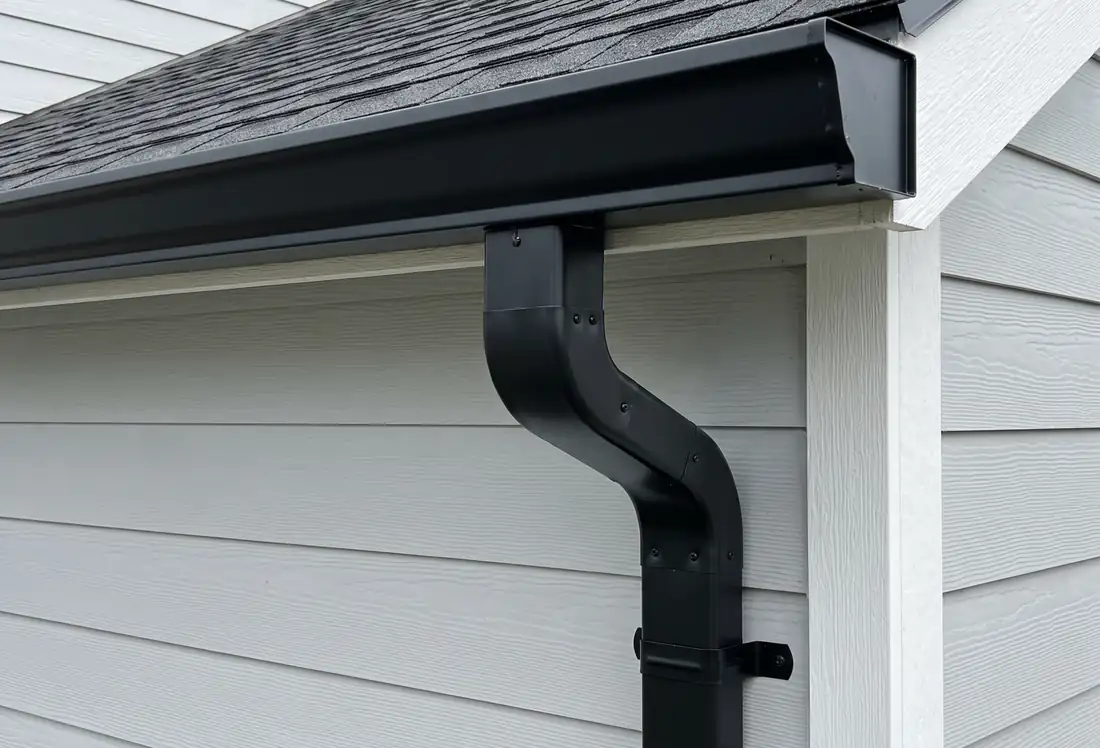
Parts of a 6-inch system
| Term | Meaning |
|---|---|
| K-style | The common profile with a flat back and a shaped front. Also called ogee |
| Outlet | The drop tube sealed into a hole in the gutter floor. The downspout connects to it |
| Downspout | The vertical pipe from gutter to ground. Also called a leader |
| Elbow | The angled piece that turns a downspout. A-style turns front to back. B-style turns side to side |
| Valley diverter | A small upright fin in the gutter or on the roof that slows the stream from a roof valley |
| Hidden hanger | A clip inside the gutter with a long screw through the back into the fascia |
| Fascia | The board fixed across the ends of the rafters. The gutter hangs on it |
| Gauge | Metal thickness. Residential aluminum is 0.027 or 0.032 inch. Copper is sold as 16 or 20 ounce |
What size gutters does a house in Marietta need?
It depends on the roof that drains to each run. A low-pitched ranch does well with 5-inch gutter. A two-storey house with a steep roof, valleys and long runs needs 6-inch on at least part of it. With about 54.6 inches of rain a year and summer storms that drop it fast, the margin for error is small.
A contractor works it out like this:
- Measure the roof plane that feeds each gutter
- Multiply by a factor for pitch, since steep roofs catch wind-driven rain and shed it faster
- Compare with what one downspout of a given size can carry
- Add outlets or go up a size where the numbers fall short
How many downspouts does 6-inch gutter need?
A common rule of thumb allows about 600 square feet of roof for each 2x3 downspout and about 1,200 for each 3x4. So a 6-inch gutter with 3x4 downspouts every 40 feet handles most houses. Below a valley, put a downspout within a few feet.
| Roof draining to the run | Gutter | Downspouts |
|---|---|---|
| Up to 600 sq ft | 5-inch | One 2x3 |
| 600 to 1,200 sq ft | 5-inch or 6-inch | Two 2x3 or one 3x4 |
| Over 1,200 sq ft | 6-inch | 3x4, one per 1,200 sq ft |
| Any run below a valley | 6-inch | 3x4 near the valley |
Is 6-inch gutter better under pine trees?
Yes, for a second reason. The wider trough and the 3x4 outlet pass pine straw that would plug a smaller system. A handful of needles bridges a 2x3 outlet. The same handful washes through a 3x4.
Does 6-inch gutter need special hanging?
It holds more water, so it weighs more when full. Hangers go at two-foot centers or closer, with screws into solid fascia or rafter tails. Aluminum of 0.032 inch keeps the front edge from flexing. If the fascia is narrow, a contractor may add a board or use roof straps.
What does the upgrade cost?
National price guides put 6-inch seamless aluminum at about $11 to $17 a foot fitted, against $9 to $14 for 5-inch. On a 180-foot house that is a few hundred dollars more. Upsizing only the runs that need it costs less.
How do I know if my current gutters are too small?
Watch them, clean, in a hard thunderstorm. Signs of an undersized system are water sheeting over the front edge along a whole run, a jet clearing the gutter below a valley, and a downspout running full while the gutter above it still spills. Stains on the fascia and washed-out mulch below the eave show where it has been happening. If only one or two runs show these signs, upsize those runs.