
On this page
- What gets installed
- How a sound installation goes
- Built for Marietta conditions
- Questions to ask before you agree
- What it costs
- The parts of a gutter system
- What size gutters does a house in Marietta need?
- How long does gutter installation take?
- What should a written quote include?
- Do I need a permit for new gutters in Marietta?
- When is the best time of year to install gutters?
- What about new construction and additions?
What gets installed
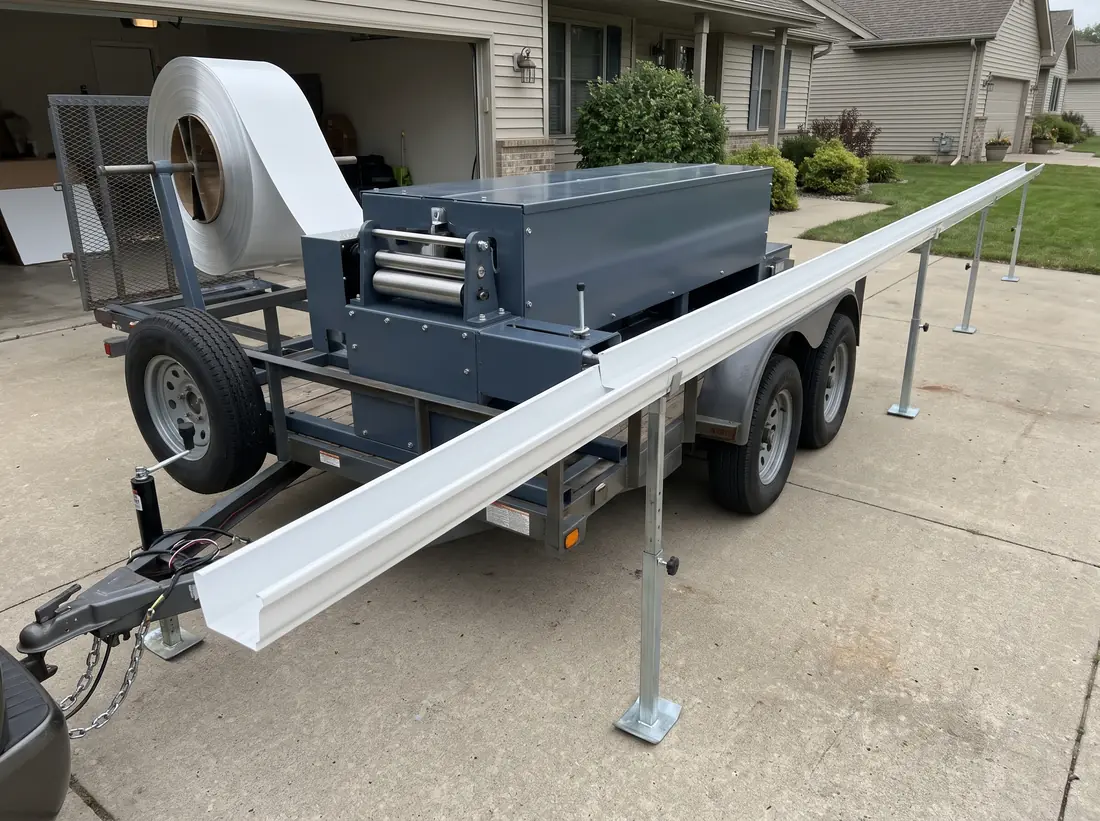
Most Marietta houses are fitted with seamless aluminum K-style gutter, 5 or 6 inches wide, with rectangular downspouts. The contractor brings a coil of painted aluminum and a forming machine, and makes each length to fit the wall it is going on.
| Choice | Usual answer | When to choose differently |
|---|---|---|
| Profile | K-style | Half-round on older houses near the Square |
| Width | 5-inch | 6-inch for large or steep roofs and long runs |
| Metal | Aluminum | Steel for strength, copper for period houses |
| Joints | Seamless | Sectional only on sheds and small outbuildings |
| Downspouts | 2x3 with 5-inch, 3x4 with 6-inch | More downspouts on long runs |
How a sound installation goes
- Measure and plan. Every roof edge is measured. The contractor decides where the high point of each run is and where each downspout will stand.
- Check the fascia. The board behind the gutter is probed for rot. Soft wood is replaced first, because it will not hold a screw. In a humid climate this step finds something more often than not on an older house.
- Form the gutter. Each length is run out of the machine and cut to the inch.
- Hang it. Hidden hangers are screwed through the back of the gutter into the fascia, no more than two feet apart. The run falls toward the outlet by about a quarter inch in ten feet.
- Seal the joints. Corners, end caps and outlets are sealed on the inside.
- Fit downspouts. Each is strapped to the wall and ends in an elbow and an extension.
- Test. Water is run through from the high end.
Built for Marietta conditions
A lot of rain, all year. The city receives about 54.6 inches of rain a year. February is the wettest month and July is close behind. A gutter here works in every season, and it has to carry the heaviest ten minutes of a summer storm. That is a question of width, downspout size and the number of outlets.
Sloping lots. Cobb County is upper Piedmont country, with ridges and creek valleys. Many houses stand on a slope with a walkout basement, so the rear gutter is high above the ground. Tall walls mean longer downspouts, more ladder work and a higher price for the back of the house than the front.
Red clay. Clay soaks up water slowly. Where the downspouts discharge matters as much as the gutter. See the guide to downspout drainage.
Pines and hardwoods. A new gutter under trees fills quickly. Decide on gutter guards at the same time as the gutter, because fitting them together costs less than a second visit.
Questions to ask before you agree
- What thickness is the aluminum? Ask for 0.027 or 0.032 inch.
- What hangers, and how far apart?
- How many downspouts, what size, and where will each one release its water?
- Is fascia repair included if rot is found, and at what price per foot?
- Will the old gutters be taken away?
- Will water be run through the system before the crew leaves?
What it costs
Published national guides put seamless aluminum at about $9 to $14 a foot fitted for 5-inch gutter and $11 to $17 for 6-inch. Those are national ranges and not local quotes. The Marietta cost guide explains what moves a price inside the range.
The parts of a gutter system
| Term | Meaning |
|---|---|
| K-style | The common profile with a flat back and a shaped front. Also called ogee |
| Half-round | A semicircular gutter hung on brackets. The profile used before the 1950s |
| Coil | The roll of flat painted metal that a seamless machine forms into gutter |
| Fascia | The board fixed across the ends of the rafters. The gutter hangs on it |
| Drip edge | Metal flashing under the first row of shingles that sends water into the gutter and not behind it |
| Gutter apron | A wider L-shaped flashing that laps from the roof deck into the gutter. Used where drip edge is missing or short |
| Hidden hanger | A clip inside the gutter with a long screw through the back into the fascia |
| Hand-cut miter | A corner cut and folded from the gutter itself, riveted and sealed. The neatest type |
| End cap | The flat piece that closes the end of a run |
| Outlet | The drop tube sealed into a hole in the gutter floor. The downspout connects to it |
| Elbow | The angled piece that turns a downspout. A-style turns front to back. B-style turns side to side |
| Downspout | The vertical pipe from gutter to ground. Also called a leader |
| Strap | The band that fixes a downspout to the wall |
| Extension | A length of downspout or hinged flap that carries water out from the wall |
What size gutters does a house in Marietta need?
Most single-storey houses need 5-inch K-style gutter with 2x3 downspouts. Two-storey houses with steep or cut-up roofs need 6-inch gutter with 3x4 downspouts on at least the runs below valleys. The deciding factors are the roof area feeding each run, the pitch, and the number of outlets. See 5-inch vs 6-inch.
| House type common in Cobb County | Usual gutter | Downspouts |
|---|---|---|
| 1950s to 1970s brick ranch | 5-inch K-style | 2x3, one per 30 to 40 feet |
| Split-level or split-foyer | 5-inch, 6-inch on the tall side | 3x4 on the tall side |
| Two-storey traditional with basement | 6-inch at rear and valleys | 3x4 |
| Large custom home, steep roof | 6-inch throughout | 3x4, extra outlets |
| Historic house near the Square | 6-inch half-round | 4-inch round |
| Townhouse | 5-inch or 6-inch | 3x4, piped to a drain |
How long does gutter installation take?
A single-storey house is usually done in half a day to a day. A two-storey house with a walkout basement takes a full day. Fascia repair, guards and buried drain lines add time. The forming machine needs a clear, level place to park, and the crew needs access all round the house.
What should a written quote include?
- Total length of gutter and number of downspouts
- Profile, width, metal and thickness
- Color of gutter and downspouts
- Hanger type and spacing
- Corner type
- Where each downspout will discharge, and any extensions or drain lines
- Removal and disposal of old gutters
- Price per foot for fascia replacement if rot is found
- Payment terms
Do I need a permit for new gutters in Marietta?
Ask before work starts. Rules differ by jurisdiction, and work in a historic district or changes to how stormwater leaves a lot can need approval. The City of Marietta answers for addresses inside the city. Cobb County answers for unincorporated areas such as East Cobb or Vinings.
When is the best time of year to install gutters?
Any dry day. Marietta has no long dry season, so the practical answer is before the next wet spell. Late fall, after leaf drop, and late spring, after pollen and tassels, are good times because the new gutter starts clean. Before February, the wettest month, is better than after.
What about new construction and additions?
On a new house or addition, gutters go on after roofing, fascia paint and siding are finished. Plan the downspout positions with the grading and landscaping, so water is led to where the lot drains.