
On this page
- How many downspouts
- Where the water should go
- Sloping lots
- Common faults
- Rules
- Downspout and drainage terms
- How is a downspout installed?
- What size downspout do I need in Marietta?
- How is a buried drain line laid?
- Where should downspouts not go?
- Rain barrels and rain gardens
- How much does it cost to add or move a downspout?
How many downspouts
A common rule is one downspout for every 30 to 40 feet of gutter, and one near every valley. A long run with a single outlet overflows at the far end in a heavy storm. Adding a downspout is one of the cheapest improvements to a gutter system.
| Downspout | Pairs with | Notes |
|---|---|---|
| 2x3 inch | 5-inch gutter | Blocks easily with pine straw |
| 3x4 inch | 6-inch gutter, or busy 5-inch runs | About twice the flow. Passes debris better |
| Round, 3 or 4 inch | Half-round gutter | Used on older houses |
Where the water should go
Georgia red clay absorbs water slowly. Water released at the foot of the wall stays there. The aim is to carry it at least several feet out and onto ground that falls away from the house.
- Splash block. The minimum. Works only if the ground slopes away.
- Extension. A length of downspout or a hinged extension carrying water four to six feet out.
- Buried drain line. A solid pipe from the downspout to a pop-up emitter or to daylight lower on the lot. Tidy, and it suits sloping lots.
Sloping lots
Much of Cobb County is ridge and creek valley. On a lot that falls away at the back, downspout water should be released where it will not cut a channel in the slope or run onto a neighbor's lot. A buried line to a level spreader or a rock apron slows it down. On the uphill side of the house, water must be turned around the building and not left to run toward the wall.
Common faults
- A downspout from an upper roof emptying onto a lower roof and overloading its gutter
- Extensions removed for mowing and never put back
- Buried lines blocked with roots or crushed by a vehicle
- Downspouts discharging onto a driveway or walk
Rules
Roof water should stay on your own lot until it reaches a proper drainage path. Connecting downspouts to anything underground that you did not install, or sending water toward the street or a neighbor, can raise questions. The City of Marietta or Cobb County can say what applies at your address.
See also downspout repair and the guide to downspout drainage and your foundation.
Downspout and drainage terms
| Term | Meaning |
|---|---|
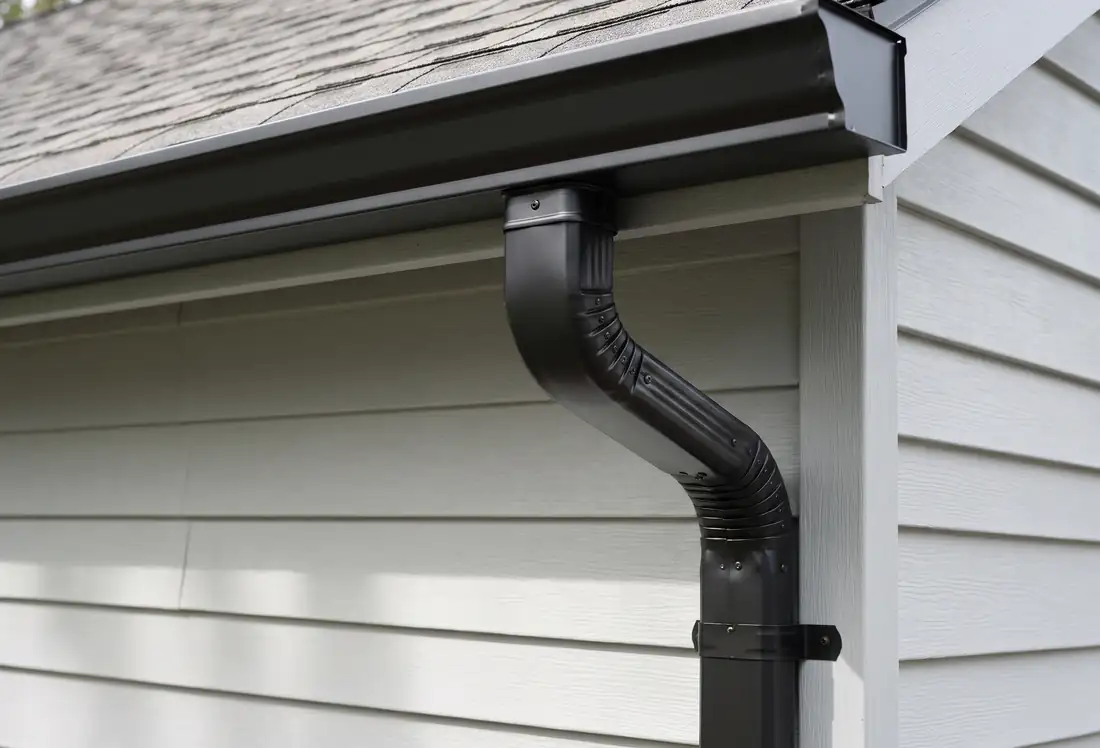
| Downspout | The vertical pipe from gutter to ground. Also called a leader |
| Outlet | The drop tube sealed into a hole in the gutter floor. The downspout connects to it |
| Elbow | The angled piece that turns a downspout. A-style turns front to back. B-style turns side to side |
| Strap | The band that fixes a downspout to the wall |
| Splash block | A sloped pad under a downspout that spreads water and stops it digging a hole |
| Extension | A length of downspout or hinged flap that carries water out from the wall |
| Cleanout | An access fitting at the foot of a downspout where it enters a buried pipe |
| Pop-up emitter | A lidded outlet in the lawn at the end of a buried drain line. Water pressure lifts the lid |
| Collector head | A box at the top of a downspout that takes water from a scupper or two gutters. Also called a conductor head |
How is a downspout installed?
- The outlet position is marked where water can be led away at ground level
- A hole is cut in the gutter floor and the outlet sealed in
- An A-style elbow turns the pipe back to the wall, and a second brings it vertical
- The downspout is cut to length and each piece slipped inside the one below
- Straps fix it to the wall at the top, the bottom and every few feet between
- A bottom elbow turns the water out onto a splash block, an extension or into a drain line
What size downspout do I need in Marietta?
Use 3x4 wherever pine straw is a problem or the roof is large. A rule of thumb gives a 2x3 about 600 square feet of roof and a 3x4 about 1,200. In a climate with intense summer rain, the larger size costs little more and blocks far less.
How is a buried drain line laid?
- A trench is dug from the downspout to the outlet point, falling all the way
- Solid smooth-wall pipe is laid. Thin corrugated pipe traps silt and crushes
- A cleanout or adapter joins the downspout to the pipe, so it can be flushed
- The pipe ends at a pop-up emitter in the lawn, or at daylight on a slope with rock under it
- The trench is backfilled and the turf replaced
Before digging, have underground utilities marked. Georgia's free locate service is reached by dialing 811.
Where should downspouts not go?
- Onto a lower roof without a pipe to carry the water on to that roof's gutter
- Across a walkway or onto a driveway that slopes to the garage
- Against the uphill wall of a house on a slope
- Toward a neighbor's lot
- Into a septic field
Rain barrels and rain gardens
A diverter in the downspout fills a barrel for garden use. A rain garden is a shallow planted basin that takes roof water and lets it soak in. On clay it needs amended soil and an overflow route. Both keep water on the lot, and neither removes the need for a way out when they are full.
| Outlet method | Typical use on Cobb County lots |
|---|---|
| Splash block | Front of house on a gentle slope |
| 4 to 6 foot extension | Most walls |
| Buried line to emitter | Flat yards, paths in the way |
| Buried line to daylight | Sloping rear yards |
| Rain barrel with overflow | Garden beds |
How much does it cost to add or move a downspout?
No local price list is published. Adding a downspout is a small job: one outlet, two or three elbows, a length of pipe, straps and an extension. Moving one also means patching the old outlet hole and may mean resetting the fall of the run. A buried drain line costs more, by the foot, because of the digging. Ask for each as a separate line on the quote.