
On this page
- How seamless gutter is made
- Why joints matter here
- Sizes and metals
- What to check on the day
- Limits
- Cost
- Terms used on a seamless gutter quote
- How are seamless gutters installed on a Marietta house?
- What corners are used on seamless gutter?
- Which color and finish should I choose?
- Does seamless gutter need less cleaning?
- How do I check the work afterward?
- What do I ask a contractor about seamless gutters?
How seamless gutter is made
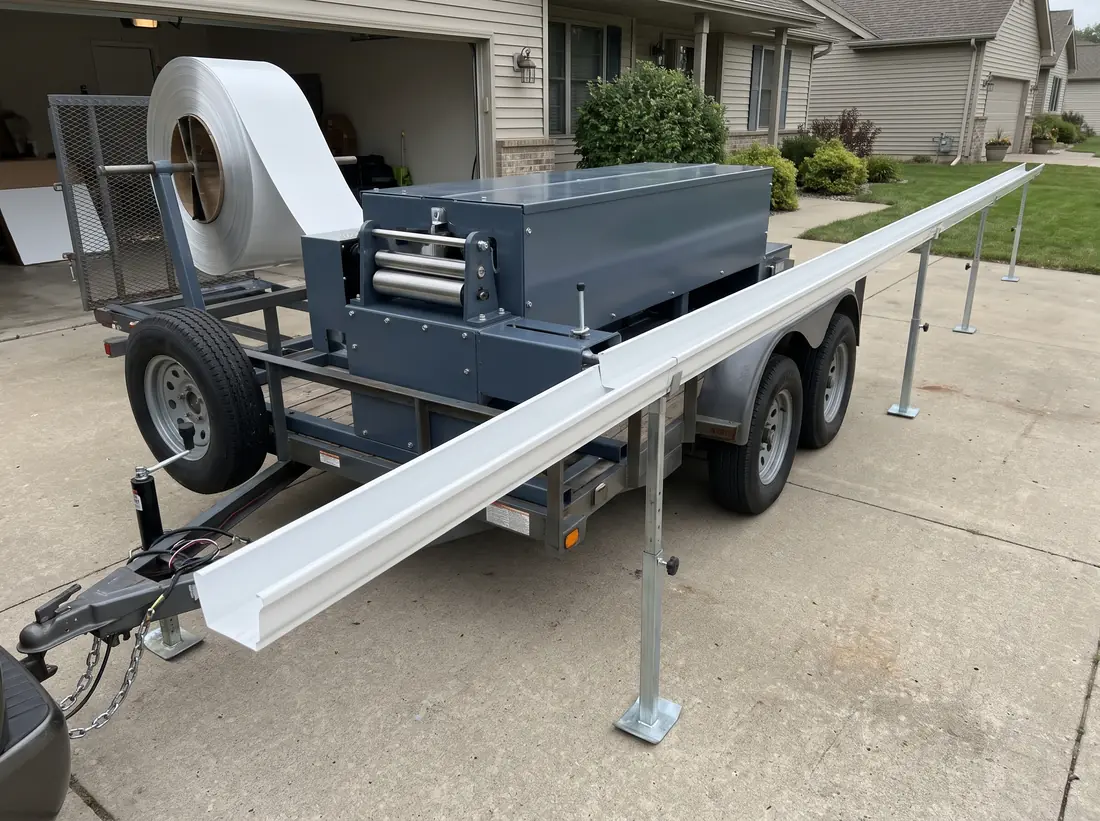
A flat coil of painted aluminum is fed through a set of rollers mounted in a truck or trailer. The rollers fold it into the K-style profile and it comes out as finished gutter. The contractor cuts it when it reaches the length of the wall. A 60-foot run is one piece.
Why joints matter here
Every joint in a gutter relies on sealant. Sealant ages in heat, and Marietta summers are long, with average highs of 87 to 89 degrees from June to August. Sectional gutter has a joint every ten feet. Seamless gutter has joints only at corners, end caps and outlets. Fewer joints means fewer places to drip, and fewer ledges for pine needles to catch on.
Sizes and metals
| Option | Detail |
|---|---|
| 5-inch K-style | The standard residential size |
| 6-inch K-style | About 40 percent more capacity, for large or steep roofs |
| Aluminum | 0.027 or 0.032 inch thick. See aluminum gutters |
| Steel and copper | Can also be roll-formed. See copper gutters |
What to check on the day
- Each run is one piece from corner to corner
- Hidden hangers no more than two feet apart
- A visible fall toward each outlet
- Corners sealed on the inside, with a neat mitre
- Downspouts strapped at top and bottom, and in the middle on tall walls
Limits
A very long run needs an outlet at each end or an expansion joint, because aluminum grows and shrinks with temperature. Seamless half-round is available but needs a different machine, so fewer contractors offer it. See half-round gutters.
Cost
Published national guides put seamless aluminum at about $9 to $14 a foot fitted for 5-inch. The cost guide explains the range. For a comparison with sectional gutter, see seamless vs sectional.
Terms used on a seamless gutter quote
| Term | Meaning |
|---|---|
| Coil | The roll of flat painted metal that a seamless machine forms into gutter |
| K-style | The common profile with a flat back and a shaped front. Also called ogee |
| Hidden hanger | A clip inside the gutter with a long screw through the back into the fascia |
| Hand-cut miter | A corner cut and folded from the gutter itself, riveted and sealed. The neatest type |
| Box miter | A pre-formed corner piece that both gutters slide into. Two joints instead of one |
| End cap | The flat piece that closes the end of a run |
| Outlet | The drop tube sealed into a hole in the gutter floor. The downspout connects to it |
| Fall | The slope of a gutter toward its outlet, about a quarter inch in ten feet |
| Expansion joint | A flexible joint that lets a long run grow and shrink with temperature |
How are seamless gutters installed on a Marietta house?
The crew measures each roof edge, runs the gutter out of the machine to that length, and carries it to the wall in one piece. In order:
- The old gutter comes down and the fascia is checked for rot
- A chalk line is snapped along the fascia to set the fall toward each outlet
- The outlet holes are cut on the ground and the drop tubes sealed in
- End caps are crimped and sealed
- Two people lift the run and fix it with hidden hangers, starting at the high end
- Corners are joined, riveted and sealed on the inside
- Downspouts, elbows and straps go on, then extensions at the ground
On a house with a walkout basement, the rear run is lifted from ladders with standoffs or from a lift. Ask how the crew plans to handle it.
What corners are used on seamless gutter?
There are three. A strip miter covers a 45-degree joint with a metal strip. A box miter is a factory corner piece that adds a second joint. A hand-cut miter is folded from the gutter itself and has the least sealant showing. All three work when sealed properly. The hand-cut corner is the neatest and gives pine needles the least to catch on. Ask which one is in the price.
Which color and finish should I choose?
| Color | Notes for Georgia |
|---|---|
| White | Matches most trim. Shows red clay splash and mildew streaks |
| Bronze or dark brown | Hides staining. Common with brick |
| Black | Popular on newer farmhouse styles. Runs hotter in full sun |
| Clay, wicker, almond | Blends with siding and stone |
| Copper-look | Painted aluminum in a copper tone |
Spring pollen coats everything here for a few weeks. It rinses off.
Does seamless gutter need less cleaning?
No. It holds the same debris as any gutter. What it avoids is the drip at each joint and the ledge where needles gather. Under pines it still needs cleaning or a micro-mesh guard.
How do I check the work afterward?
Run a hose at the high end of each run. Water should travel to the outlet without pooling, the corners should stay dry underneath, and each downspout should discharge at the bottom within a few seconds. Do this before the final payment.
What do I ask a contractor about seamless gutters?
- Do you form the gutter on site, and in which widths?
- What thickness of aluminum is on the coil?
- Which corner type do you use?
- How far apart are the hangers?
- How many downspouts, and where does each one discharge?
- Is fascia repair priced per foot if needed?
- Will you test it with water before leaving?
A contractor who answers these without hesitation has usually done the job well many times.