
On this page
- The four causes
- How to tell which
- Why it shows up in Marietta
- Fixes
- What overflow does
- Parts involved in overflow
- How do you fix a gutter that overflows?
- Why do gutters overflow at the corners?
- Why does water run behind my gutter?
- Does overflow damage the house?
- Can I test my gutters without waiting for rain?
- What do I tell a contractor about overflow?
The four causes
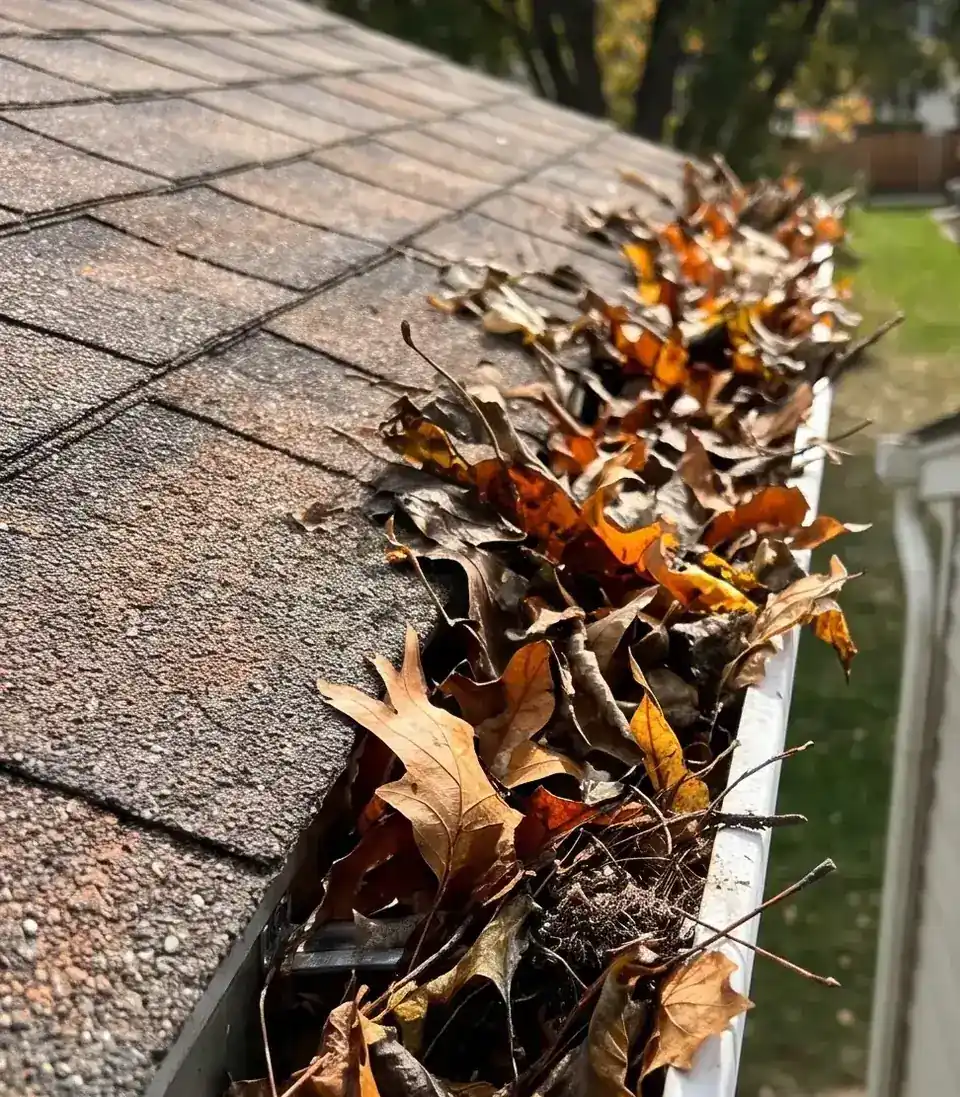
1. Blockage. Pine straw, leaves and shingle grit fill the gutter or plug the outlet. Water has nowhere to go. This is the most common cause in Marietta and the cheapest to fix. See gutter cleaning.
2. Too few or too small downspouts. The gutter is clear but the water cannot leave fast enough. The gutter fills from the outlet backward and spills at the far end.
3. Wrong fall. The run is level, or it has sagged in the middle, so water pools and spills at the low point. See sagging gutters.
4. Gutter too small or badly placed. On a steep roof, water runs fast and overshoots a narrow gutter, especially below a valley.
How to tell which
| What you see in heavy rain | Points to |
|---|---|
| Overflow everywhere, trickle from the downspout | Blockage |
| Overflow at the end farthest from the downspout | Too few downspouts |
| Overflow at one spot in the middle of a run | Sag or wrong fall |
| A jet of water clearing the gutter below a valley | Overshoot. Needs a diverter or a wider gutter |
| Water behind the gutter | Missing or short drip edge |
Watching the gutter from the ground in a storm tells a contractor more than a dry inspection. Take a short video if you can.
Why it shows up in Marietta
The city gets about 54.6 inches of rain a year, much of it in bursts. A system that copes with steady rain can fail in a thunderstorm. Many houses were built with the fewest downspouts that would pass, and trees have grown over the roof since.
Fixes
- Clean and flush, then retest
- Add a downspout at the overflowing end, or enlarge 2x3 downspouts to 3x4
- Reset the fall by re-hanging the run
- Fit a valley diverter to slow and spread the stream
- Upsize the worst runs to 6-inch gutter
What overflow does
Water that misses the gutter falls at the foot of the wall. On clay it stands there. It also splashes soil onto siding, rots the fascia and washes out beds. See downspout drainage and your foundation.
Parts involved in overflow
| Term | Meaning |
|---|---|
| Outlet | The drop tube sealed into a hole in the gutter floor. The downspout connects to it |
| Downspout | The vertical pipe from gutter to ground. Also called a leader |
| Valley diverter | A small upright fin in the gutter or on the roof that slows the stream from a roof valley |
| Fall | The slope of a gutter toward its outlet, about a quarter inch in ten feet |
| Drip edge | Metal flashing under the first row of shingles that sends water into the gutter and not behind it |
| Hidden hanger | A clip inside the gutter with a long screw through the back into the fascia |
| Elbow | The angled piece that turns a downspout. A-style turns front to back. B-style turns side to side |
How do you fix a gutter that overflows?
Work through the causes in order of cost:
- Clean the run and flush the downspout. Test with a hose
- Check the fall with a level. Re-hang if water pools
- Open up the outlet. Replace a small outlet with a wide-mouth one
- Add a downspout at the end that floods
- Fit a valley diverter where a roof valley overshoots
- Upsize that run to 6-inch if it still cannot cope
Most houses are fixed by step three or four.
Why do gutters overflow at the corners?
Inside corners sit below roof valleys, where two roof planes pour onto one spot. Water arrives fast and with momentum. A diverter spreads it along the gutter, and a downspout near the corner takes it away. In K-style gutter, the inside corner is also where debris collects first.
Why does water run behind my gutter?
Either the roof has no drip edge, so water clings to the underside of the shingles and runs down the fascia, or the gutter is hung so low that water drops behind it. A gutter apron fixes the first. Re-hanging fixes the second.
| Overflow point | First thing to check |
|---|---|
| Whole length | Blocked outlet or downspout |
| Far end from downspout | Too few outlets |
| Middle of run | Sag |
| Inside corner | Valley overshoot, debris |
| Behind the gutter | Drip edge or apron |
| Over a guard | Guard pitch or clogged surface |
Does overflow damage the house?
Over time, yes. It rots fascia and soffit, stains siding, erodes beds and soaks the clay beside the foundation. In a crawl-space house, that moisture feeds mold and wood decay under the floor.
Can I test my gutters without waiting for rain?
Yes. Put a hose in the high end of each run and turn it full on. Watch for pooling, drips and how quickly water leaves the downspout. It will not match a thunderstorm, but it shows blockages and wrong fall.
What do I tell a contractor about overflow?
Say where it happens, how heavy the rain has to be, and when the gutters were last cleaned. A short phone video taken in a storm is the most useful thing you can offer. Mention any downspouts that go underground, since a blocked buried line backs water up into the gutter and looks like every other cause.