
On this page
- Historic Marietta at a glance
- An old county seat
- Six historic districts
- The right profile
- Old roof edges
- Big trees
- Cottages with open eaves
- What is the best gutter setup for Historic Marietta?
- What size gutters does a house in Historic Marietta need?
- What gutter work is common in Historic Marietta?
- Do I need approval to change gutters in a historic district?
- How do rain, soil and terrain in Historic Marietta affect gutters?
- When should gutters in Historic Marietta be cleaned?
- Roads, water and landmarks in Historic Marietta
- Services and cost in Historic Marietta
- Nearby areas
Historic Marietta at a glance
| City | Marietta, Cobb County seat |
| Historic districts | Six, including Northwest Marietta, Whitlock Avenue, Washington Avenue and Church-Cherokee Streets |
| Oldest houses | Oakton House (1838), William Root House (about 1845) |
| Typical gutter work | Half-round, copper, fascia and rafter-tail repair |
An old county seat
Marietta was legally recognized in 1834 and incorporated in 1852. Fires in the 1850s destroyed much of the city three times. The Kennesaw House is one of four commercial buildings that were not burned in 1864. Oakton House, from 1838, is the oldest continuously occupied residence, and the William Root House, from about 1845, is the oldest wood-frame house still standing.
Six historic districts
The city has six historic districts. Northwest Marietta, Whitlock Avenue, Washington Avenue and Church-Cherokee Streets are among them. Their houses date from before the Civil War to the twentieth century.
In a designated district, changes to the outside of a house may need approval. Ask the city's planning office before changing the profile, metal or color of gutters on a street-facing wall.
The right profile
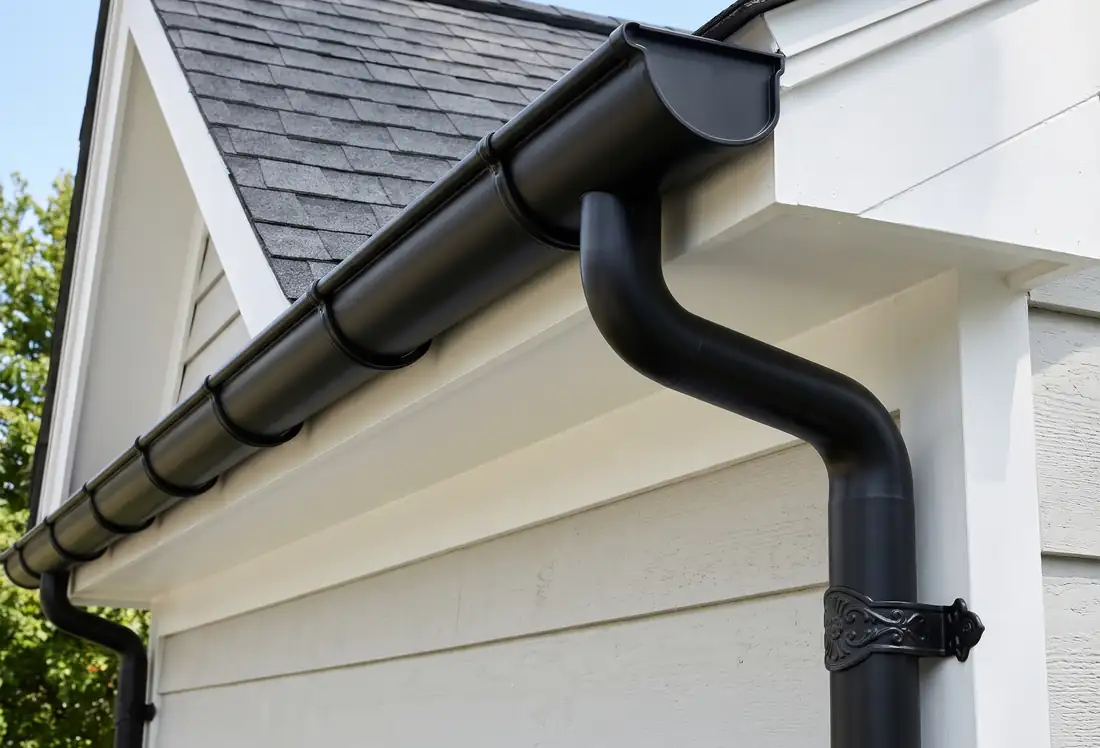
Houses of this age were built with half-round gutters, or with gutters built into the roof edge. A modern K-style gutter hides the crown moulding and rafter tails that give these houses their character.
- Half-round gutter on brackets leaves the trim visible
- Copper or painted steel is closest to the original
- Round downspouts suit the profile
Old roof edges
Before anything is hung:
- Rafter tails and fascia are probed for rot
- Built-in or box gutters are inspected. If the lining has failed, water has been entering the eave
- Old downspouts that run into buried clay pipe are tested. Those pipes are often broken
Big trees
The old streets have large, mature trees close to the houses. Gutters under them need cleaning at least twice a year, and outlets should be checked after storms.
Cottages with open eaves
Some smaller, later houses have open eaves with exposed rafter tails. Gutters fix to the tails with brackets or to a fascia added later. Either way, 6-inch half-round usually suits them.
What is the best gutter setup for Historic Marietta?
| Item | Recommendation for Historic Marietta |
|---|---|
| Gutter | 6-inch half-round on period houses. 5-inch or 6-inch K-style on later houses |
| Material | Copper, or painted aluminum or steel |
| Downspouts | 4-inch round with half-round |
| Hangers | Brackets on the fascia or rafter tails |
| Guards | Micro-mesh made for half-round, where trees overhang |
| Cleaning | Twice a year at least |
| Discharge | To a drain or onto gravel. Old buried clay pipes tested first |
| Main risks | Rot at old roof edges, failed built-in gutters, broken clay drains |
| Who to ask about permits | City of Marietta, including its historic preservation review |
What size gutters does a house in Historic Marietta need?
On a period house, 6-inch half-round with 4-inch round downspouts. Half-round holds less than K-style at the same width, so the larger size is needed for Georgia rain. Later houses on the same streets can carry ordinary K-style gutter.
What gutter work is common in Historic Marietta?
| House type | Common work |
|---|---|
| Antebellum or Victorian house | Half-round in copper, rafter-tail and fascia repair |
| Early twentieth-century house with open eaves | Half-round on brackets, round downspouts |
| House with built-in gutters | Relining, or half-round hung below |
| Later infill house | K-style in a color that suits the street |
Do I need approval to change gutters in a historic district?
Possibly. The City of Marietta reviews exterior changes to properties in its locally designated districts. Replacing like with like is usually simpler than changing profile or material. Call the city before ordering, and keep photographs of what was there.
How do rain, soil and terrain in Historic Marietta affect gutters?
No separate rainfall figure is quoted here for Historic Marietta. Marietta, in the same part of north Georgia, averages 54.6 inches a year, with February the wettest month and July close behind. On older houses that rain has been falling on the same roof edge for generations. The wood behind the gutter has been wet and dry thousands of times, and red clay round the foundation has been soaked by short downspouts for as long. In Historic Marietta the practical rules are: repair the roof edge before hanging anything, add drip edge or a gutter apron where there is none, test old buried drains before reusing them, and carry downspout water well away from old foundations.
When should gutters in Historic Marietta be cleaned?
Trees here are mainly white oak, water oak, southern magnolia, dogwood and crape myrtle.
| Season | What falls | What to do |
|---|---|---|
| Spring | Oak tassels, maple seeds and pollen strings mat over outlets | Clean in late spring when the tassels stop |
| Summer | Little falls. Storms bring down twigs and small limbs | Look at outlets after any severe storm |
| Fall | Heavy leaf fall. Oaks drop last, often into December | Clean once the oaks have finished |
| Winter | Late leaves and acorns. February is the wettest month | Check downspouts run clear going into February |
Roads, water and landmarks in Historic Marietta
- Roads: Whitlock Avenue, Church Street, Cherokee Street, Kennesaw Avenue, Washington Avenue, Polk Street
- Water: Sope Creek and Rottenwood Creek rise near the city
- Landmarks: Marietta Square and Glover Park, the Strand Theatre, the William Root House, Kennesaw House, Marietta National Cemetery
- Neighbors: Fair Oaks, Kennesaw, East Cobb, Smyrna
Services and cost in Historic Marietta
A contractor serving Historic Marietta can handle installation, repair, guards, replacement and cleaning. Price depends on the length of gutter, the metal and the height of the house, not on the town. The cost guide gives published ranges.
Nearby areas
Fair Oaks, Kennesaw, East Cobb, Smyrna. All areas are listed on the service areas page.